
Pesticide Use Regulations
In Canada, approved pesticides are registered under the Pest Control Products Act. The provincial Integrated Pest Management Act and associated Regulation set out requirements and guidelines for pesticide use in British Columbia. This page is intended to summarize the pesticide use regulations relevant for noxious weed and invasive plant species management. Consult the regulations for information on other pesticide uses.
Key Takeaways:
A pesticide user license and applictor certificate is required for most noxious weed and invasive plant species herbicide application in BC. Licensees will need to follow standards for pesticide use, storage, and transport and abide by designated pesticide free zones.
License and Certification Requirements for Pesticide Application
Pesticide use for the purpose of controlling noxious weeds or invasive plant species will require one or more of the following, depending on the scale and method of application:
- Pesticide use notice confirmation
- Permit
- Pesticide user license
A pesticide use notice is required for management of noxious weeds or invasive plants on more than 50 hectares of public land managed by a single entity per year. It will require the preparation of a Pest Management Plan, public consultation, and a confirmation of receipt of a pesticide use notification from the Ministry of Environment. For more information, consult the Noxious Weed/Invasive Plant Review Paper.
A permit is required for aerial application or the use of permit-restricted pesticides, as defined by the Pest Control Products Act. A permit is also required if a license or confirmation holder requires an exemption from a pesticide use standard (as described below).
A pesticide user license is typically the only requirement for smaller-scale herbicide application with the purpose of controlling noxious weeds or invasive plants. A service user license is required for any person (or business) that applies a non-excluded pesticide under a contract for services. This means that any contractor hired to apply pesticides on public or private land for the purpose of invasive species control must have a pesticide user license. A non-service user license is required for anyone using a pesticide to manage noxious weeds or invasive plants on public land (<50 ha/year), even if they are not providing a contracted service. For more information about user licenses and when they are required, consult this page on pesticide use authorization.
All employees and contractors of a business with a valid pesticide user license can operate under that license (each individual applicator does not need their own license). However, every pesticide applicator must hold a Industrial vegetation and noxious weed pesticide applicator certificate from the province.
Note: The application of excluded pesticides, which are listed in Schedule 2 of the Integrated Pest Management Regulation, is exempt from licencing and certification requirements.
Pesticide Use Standards
The Integrated Pest Management Regulation prescribes pesticide application standards for the purpose of managing noxious weeds or invasive plants in BC.
A license or confirmation holder is required to ensure that:
- anyone using a pesticide is informed of treatment boundaries, requirements for personal protection, and procedures to protect human health and the environment
- application equipment is in good working order
- an inspection of the area is carried out to ensure all applicable regulatory requirements and standards can be met
- precautions are taken to prevent human or wildlife exposure and protect domestic and agricultural water sources
- pesticide use does not remove vegetation necessary to prevent streambank erosion, prevent debris from entering a stream, and maintain slope stability where landslides have occurred
- reasonable efforts have been made to identify and prevent harm to biological weed control organisms that have been released
Additionally, all license or confirmation holders should refrain from:
- spraying a pesticide more than 1.5 metres from the target weed or plant
- broadcast spraying or foliar spraying outdoors if wind speed exceeds 8 km/hr
- using a residual pesticide on water saturated soil, during heavy rainfall, or if heavy rainfall is imminent
- spraying pesticide on foliage covered by ice or frost or of water is flowing on the foliage
- spraying a pesticide between 30 minutes after sunset and 30 minutes before sunrise unless a light is used so the application is visible from 30 metres away
For additional pesticide use standards, and for standards involving the storage and transport for pesticides, consult the Integrated Pest Management Regulation (Part 2, Division 7).
Treatment Notice
If using a pesticide in an outdoor public use area, a licensee must post a treatment notice:
- if the treatment area is fenced, at each gate or opening that provides access to the area; and
- if the treatment area is not fenced, at intervals around or along the area as necessary so that a notice is clearly visible
A treatment notice must:
- include the text ‘NOTICE OF PESTICIDE USE’ and a cautionary symbol
- be at least 500 cm2 in size and constructed of water-resistant materials
- include a description of the treatment area and the name of the targeted pest
- include the trade name or active ingredient of the pesticide
- mention the date and time of the use
- include precautions required to prevent harm to people entering the treatment area
- list the licensee’s license number and contact information
No Treatment Zones and Pesticide Free Zones
The Integrated Pest Management Regulation specifies no-treatment zones where pesticide application cannot occur. Generally, the no treatment zone is determined by the license holder and should be large enough to ensure that regulated pesticide free zones (PFZs) remain uncontaminated.
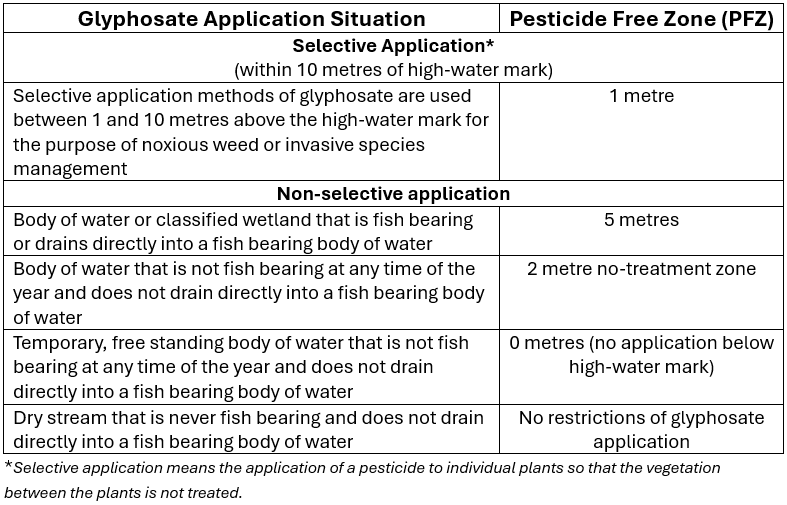
For the application of a pesticide other than glyphosate, there must be a 10-metre pesticide free zone (PFZ) around bodies of water, dry streams, and classified wetlands. The PFZ is measured horizontally from the high-water mark.
For glyphosate application, the PFZ may be reduced, as per the table below:
Pesticide Use Reporting Requirements
License and confirmation holders are required to keep detailed records of each pesticide use and submit an annual summary report to the province by January 31 of each year (for the previous year). The annual report will include:
- the name, registration number, and amount of each pesticide used
- the total area treated
For more information about reporting and record keeping, consult the Noxious Weed/Invasive Plant Review Paper.
Disclaimer: Environmental regulations change frequently. Our goal is to keep the content of this page up-to-date and accurate. If you notice inaccurate information, please contact us so we can make corrections.
Last Updated in August 2025