
British Columbia Water Sustainability Act
The provincial Water Sustainability Act (WSA) is the principal law for managing the use and diversion of water resources in British Columbia. It regulates how natural water sources can be used and when changes can be made in and about a stream.
Key Takeaways:
According to the Water Sustainability Act, all ‘Changes In and About a Stream’ require Notifications or Change Approvals from the province. Instream work should follow best management practices to minimize impacts to aquatic wildlife and water quality.
How Does the Water Sustainability Act Apply to Development?
The Water Sustainability Act requires permission for any ‘Changes In and About a Stream’. Changes In and About a Stream include:
- Any modification to the nature of a stream, including modification to the land, vegetation, and natural environment of a stream or the flow of water in a stream
- Any activity or construction within a stream channel that has or may have an impact on a stream or a stream channel (the stream channel is defined as the entirety of the bed and banks of a stream)
Under the WSA, stream is defined as:
- A natural watercourse, including a natural glacier course, or a natural body of water, whether or not the stream channel or the stream has been modified, or
- A natural source of water supply
This includes lakes, ponds, rivers, creeks, springs, ravines, and wetlands, whether or not usually containing water. Consult sections 31 to 35 of the Water Sustainability Regulation for specific water features that are exempt.
Note: Proposed instream work may also need approval under the Fisheries Act. Disturbance in riparian areas above the top of bank of a stream is managed by local governments through the provincial Riparian Areas Protection Regulation.
Types of Water Sustainability Act Permissions
Depending on the nature of the work, one of four permissions may be required:
- Notification of Authorized Change – allows an individual to make Changes In and About a Stream without an official approval
- Change Approval – allows an individual to make Changes In and About a Stream
- Water License or Water Use Approval – allows an individual to make Changes In and About a Stream and provides rights to divert, use, or store water
- Order – a WSA engineer can order Changes In and About a Stream in an emergency or enforcement situation
Authorized changes and change approvals are the most relevant for development in the Lower Mainland and will be the main subject of this page.
Notification of Authorized Changes In and About a Stream
Some Changes In and About a Stream are authorized without approval under Section 39 of the Water Sustainability Regulation (WSR). However, a Notification of Authorized Changes must still be submitted through FrontCounterBC prior to work. The table below shows a partial list of authorized changes that may be relevant in the Lower Mainland. For a full list, consult Section 39 of the Water Sustainability Regulation or Section 4.2 of the WSA User Guide.
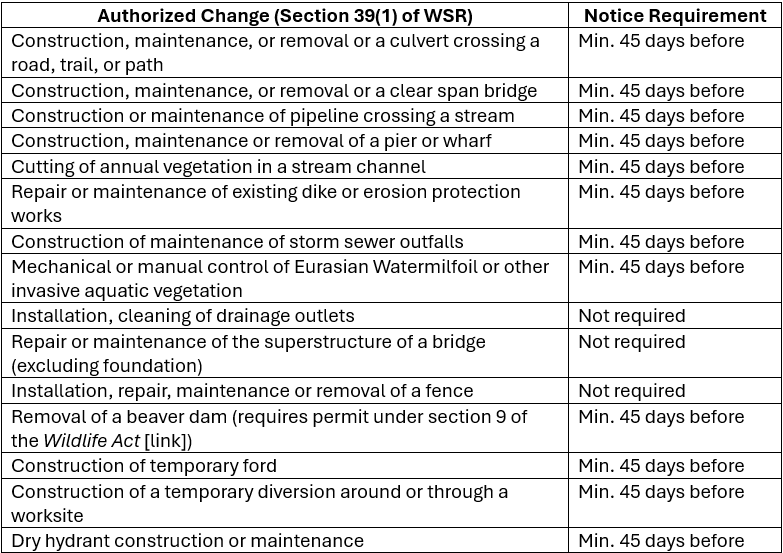
All authorized Changes In and About a Stream are subject to conditions, such as design and construction specifications, which are set out in Section 39 of the WSR. If these conditions are not met, a Change Approval will have to be submitted instead of a Notification. Changes In and About a Stream should follow the best management practices outlined by the province, as well as region-specific best management practices. Additionally, any list of terms and conditions received from a habitat officer must be followed. These terms and conditions often include:
- timing work to comply with reduced risk instream work windows
- maintaining a natural flow rate above and below the work site
- minimizing the removal of stable, natural materials from non-fish streams
- having a QEP conduct a fish and aquatic wildlife salvage, if de-watering is necessary
- taking adequate measures to ensure that equipment does not harm aquatic wildlife
- minimizing disturbance to natural materials and vegetation
- restoring disturbed areas to pre-disturbance conditions using native species and minimizing the colonization and spread of noxious weeds
- determining if Fisheries and Oceans Canada needs to be consulted
Notifications for Authorized Changes will be submitted through FrontCounterBC. If the FrontCounterBC application form does not provide enough information about the impacts of the proposed activity on the stream or aquatic environment, decision makers may require supplemental information. In some cases, a Stream and Stream Channel Impact Assessment or technical drawings may be required.
Change Approval for Changes In and About a Stream
Changes In and About a Stream that are not authorized under section 39 of the Water Sustainability Regulation require a Change Approval, submitted through FrontCounterBC. Some activities that require a change approval include:
- Bank erosion protection
- Bridge construction, other than clear span
- Culvert installation not classified as an authorized change
- Watercourse or channel realignment
- Channel or instream pond construction
- Dam or weir construction or removal
For projects that are not likely to pose a significant risk of adverse impacts to a stream, a submission of the online form through FrontCounterBC may be all that is required for a Change Approval application. However, government staff will regularly request additional information such as a project and environmental management plan (PEMP). PEMPs are generally required for the following works, but may be requested for other projects as well:
- Stream diversion/infill
- New channel or wetland construction
- Stream crossing (non-clear span)
- Debris removal
- Gravel removal
- Bank protection works
Given that requests for additional information can slow down the approval process, it is generally recommended that a PEMP be included with most initial Change Approval applications.
A project and environmental management plan must be completed by a qualified environmental professional (QEP) and should follow the guidelines in the South Coast Region WSA Guidance Document. The plan should include:
- a project overview
- impacts to other affected lands and people, including First Nations consultation
- a stream and stream channel impact assessment
- a habitat balance that aims to achieve no net loss to habitat
- supplemental plans, such as an ESC plan, construction environmental management plan, riparian planting plan, or off-setting plan
Change Approvals will also outline post-construction requirements, which often include:
- a post-construction monitoring report, prepared by a QEP, to be submitted to the province within 60 days of project completion
- annual monitoring and maintenance reports prepared by a QEP for required restoration works, typically for a period of 3-5 years following restoration
Timing for Changes In and About a Stream
If possible, Changes In and about a Stream should occur at a time of year when the risk of negative impacts to aquatic organisms is low. The Reduced Risk Instream Work Window for fish is between August 1 and September 15 in the Lower Mainland. However, these windows are species dependant, and a qualified professional should be hired to determine fish presence in a stream. Consideration should also be given to the potential presence of other aquatic organisms such as amphibians. For more information, consult the Guidelines for Reduced Risk Instream Work Windows.
Work Within Designated Sensitive Streams
The Water Sustainability Act has designated some streams as ‘Sensitive Streams’. There are 6 sensitive streams in the Lower Mainland:
- Kanaka Creek (City of Maple Ridge)
- Nathan Creek (Township of Langley)
- Silverdale Creek (City of Mission)
- West Creek (Township of Langley)
- Whonnock Creek (City of Maple Ridge)
Applicants proposing changes in and about a sensitive stream should discuss the project with the FrontCounter BC Surrey office prior to submitting an application. Additional mitigation measures and requirements may apply.
Disclaimer: Environmental regulations change frequently. Our goal is to keep the content of this page up-to-date and accurate. If you notice inaccurate information, please contact us so we can make corrections.
Last Updated in July 2025